
PNB reported the maximum number of such frauds.

These PSU banks also account for the lion's share of bad loans or NPAs plaguing the sector and need crores of rupees in new capital in the next two years to meet global Basel III capital norms.

Companies listed on the National Stock Exchange (NSE) main board increased their Corporate Social Responsibility (CSR) expenditure by 23 per cent year-on-year to Rs 22,212 crore in 2024-25 (FY25), driven by a significant jump in average net profits, according to a PRIME Database Group report.
The decision to increase the quantum of capital infusion was taken at a meeting between Finance Minister P Chidambaram, RBI Governor Raghuram Rajan and Economic Affairs Secretary Arvind Mayaram in New Delhi.

Ask rediffGURU and PF, MF and insurance expert Purshotam Lal your mutual fund, insurance and personal finance-related questions.

The Finance Ministry has called a meeting of heads of public sector banks to clear stalled projects.

If they are made accountable, bad loan cases will shrink dramatically, recoveries will rise, and the NCLT process will be more manageable, asserts Debashis Basu.

PSU bank stocks held the market's attention in morning trades on Tuesday as there's much anticipation that the Union Budget for 2003-04 may bring about the raising of foreign holding ceiling in these banks.

Central Bank of India's 21.5 per cent assets are either bad or have been restructured.

Bank of India, Canara Bank, Dena Bank, Corporation Bank and Andhra Bank are among the lenders that received capital infusion from the government.

The country's largest lender State Bank of India on Wednesday announced the completion of the divestment of about 13.18 per cent stake in Yes Bank to Sumitomo Mitsui Banking Corporation of Japan for Rs 8,888.97 crore. State Bank of India (SBI) has received Rs 8,888.97 crore from the acquirer Sumitomo Mitsui Banking Corporation (SMBC), a Japanese multinational financial services company belonging to the Sumitomo Mitsui Financial Group (SMFG), the bank said in a regulatory filing.

Tata Motors was the biggest gainer in the Sensex pack, rallying 2.94 per cent. It was followed by Vedanta, Bajaj Finance, Sun Pharma, ONGC, ICICI Bank, Bajaj Auto, Tata Steel, RIL, HDFC duo, L&T and SBI, rising up to 2.78 per cent.

For the first time, PSU banks will have a non-executive chairman, giving operational responsibility to managing director and chief executive officer.

The finance ministry has directed all state-owned banks to review their gold loan portfolio as instances of non-compliance with regulatory norms have been noticed by the government. The Department of Financial Services (DFS) in a communication addressed to heads of public sector banks has asked them to look at their system and processes related to gold loan. "We have asked banks to undertake comprehensive review of the gold loan business," financial services secretary Vivek Joshi told PTI.

The Confederation of Indian Industry (CII) has proposed a 20-point policy agenda to the finance ministry, including a conflict-linked emergency credit line guarantee scheme and tax rationalisation on energy inputs, to support MSMEs, exporters, and energy-intensive industries affected by the ongoing West Asia war.

SBI, PNB, Bank of Baroda, Canara Bank, Dena Bank, Central Bank of India ended down 3%-12% each.
A special court in Mumbai has dropped corruption charges against Guruashish Construction and its directors in a multi-crore cheating case after the CBI found no public servants involved in the alleged graft.

Arun Jaitley had promised to provide more than the budgeted amount.

The market capitalisation of BSE-listed companies eroded by Rs 9,40,581.75 crore to Rs 4,50,61,658.60 crore (USD 4.90 trillion) in a single day.

Jaitley said the total gross NPA ratio has gone up to 4.03 per cent in 2013-14 from 3.42 per cent in 2012-13 and 2.94 per cent in 2011-12.

Among Sensex firms, Bharti Airtel, Reliance Industries, Eternal, State Bank of India, Tata Steel and HDFC Bank were the major gainers. However, Kotak Mahindra Bank, Bharat Electronics, Infosys and Bajaj Finance were among the laggards.

Despite high exposure of public sector banks to power, iron and steel sectors, analysts remain in a wait-and-watch mode.

Finance Minister Nirmala Sitharaman on Tuesday held a review meeting on credit guarantee scheme with heads of public sector banks, and asked them to expedite loan disbursement under the Rs 3-lakh crore ECLGS for MSME sector, hit hard by coronavirus-induced lockdown. The meeting on Emergency Credit Line Guarantee Scheme (ECLGS) was held through video conference, and the minister appreciated the efforts of banks in execution of the scheme.

Over 50 per cent, or 660 stocks, from the BSE 1000 index recorded negative returns during CY25.

The central government is looking to strengthen the boards of public sector banks (PSBs) by specifying terms of office and conditions of service for whole-time directors, and also seeking disclosures from all directors about interests in other companies. Through the Banking Laws Amendment Bill, the government is likely to introduce conditions for disqualification of whole-time and independent directors which are not specified in the current legislation. The Centre is seeking to introduce fresh changes that are aimed at strengthening the boards of PSBs, and holding their directors accountable, an official said.

After the finance minister directed public sector banks to join the account aggregator (AA) ecosystem, 5-6 major ones, including State Bank of India (SBI) and Bank of Baroda are expected to go live by July-end. Sahmati, an industry alliance for the AA ecosystem, has been working with PSU banks to get them onboarded for quite some time now. So far, Union Bank of India and Punjab National Bank (PNB) have gone live on the AA ecosystem. While Union Bank has been live for a while, PNB went live earlier this month.

Govt renews search for five PSU bank chiefs; norms relaxed.
Finance Minister Arun Jaitley on Sunday said the government is planning to bring down its stake in public sector banks to 52 per cent so as to meet Rs 3 lakh crore capital requirement.
The pace of loan growth among public sector banks (PSBs) has seen a surge in the financial year 2024-25, and this is an exception to the overall moderation in bank credit during FY25. PSU banks' share in incremental credit rose to 57.3 per cent in March from 51.7 per cent a year ago, according to the Reserve Bank of India's (RBI's) Monetary Policy Report (April 2025).

The decision in this regard, however, is expected to be taken by the new government.

Among Sensex firms, Trent, ICICI Bank, Tech Mahindra, Bajaj Finserv, Mahindra & Mahindra, Power Grid, Tata Consultancy Services and Bajaj Finance were the major laggards. However, Tata Steel, Larsen & Toubro, State Bank of India, Kotak Mahindra Bank were among the major gainers.

'Given that India underperformed emerging markets by 28 per cent in 2025, the worst performance in over 30 years, the timing of the sharp STT hike could have been better.'
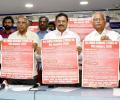
Most of the lenders had informed their customers in advance about the strike call given by All India Bank Employees Association (AIBEA), All India Bank Officers' Association (AIBOA), BEFI, INBEF, INBOC and Bank Karmachari Sena Mahasangh (BKSM), and its impact on banking services.
Public sector banks have raked in more profits in the three months ended June on the back of a persistent decline in bad loans and the trend may have a positive bearing on their balance sheets in the coming quarters. In the June quarter, Bank of Maharashtra (BoM) and State Bank of India (SBI) were in the lowest quartile as far as Gross Non Performing Assets (NPAs) and net NPAs were concerned, according to an analysis of the quarterly financial numbers published by the public sector lenders. Cumulatively, all the 12 public sector banks reported a profit of about Rs 15,306 crore in the three months ended June, registering an annual growth of 9.2 per cent. However, leading public sector lenders -- SBI and PNB -- posted lower profits in the June quarter.

The Supreme Court of India has upheld an order directing NBCC to complete 16 delayed housing projects of Supertech Limited, providing relief to thousands of homebuyers who have been waiting for nearly two decades.
The Supreme Court of India has upheld an order directing NBCC to complete 16 delayed housing projects of Supertech Limited, providing relief to thousands of homebuyers who have been waiting for nearly two decades.
Employees of public sector banks on Wednesday withdrew their proposed strike on Friday, called to protest the cases filed by the management of Central Bank of India against its employees for going on strike last month.

India's corporate bond market, driven by public sector undertaking (PSU) banks and financial institutions last year, is losing momentum since the second quarter of FY26.
